How to hide cords at the desk and behind the TV
Hide the power strip, and most of the cords go with it. Put the strip where the devices are: under the desk, behind the TV stand, on the side of a steel cabinet. What still shows can be a cord you would choose: braided, soft, in the color of the room.

4neodymium magnets in the base of Cubical C1 and Squared S1
45 mmhow thin Squared S1 is, flat under a desk
1.8 mbraided cable on both
0cords under the rug
Hide the strip, not the cords
Most of the tangle starts at the wall socket. Every device sends its own cable there, and they all meet on the floor. Move the power strip to where the devices are, and each cable gets short. One cord is left: the strip's own, back to the wall.
So the first question is where the strip goes: out of sight, and close to what it powers.

Under the desk
Cubical C1 and Squared S1 each have four neodymium magnets in the base. On a desk with a steel frame, they hold straight to it, under the top and out of sight. On wood, glass or stone, fix the metal plate that comes in the box, and the strip holds to that.
Squared S1 is 45 mm thick, with four Type F sockets on its face. Under a desk it takes the monitor, the lamp and a charger, and their cables stay off the floor.
Gather what is left into one route: along the underside of the top, down one leg, to the wall. One line looks calmer than many, and a braided cord follows a table leg the way a lamp cord does.


Behind the TV
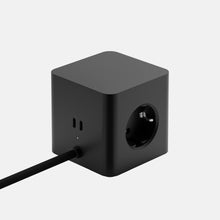
For a TV on a stand, put the strip behind the stand, close to the TV, the speaker and the router. Cubical C1 has three Type F sockets and two USB-C ports, 65 W from one port or 45 W and 20 W with both in use, so a phone or a tablet charges from the same cube.
For a TV on the wall, aim for one straight drop. Gather the TV's cables into one bundle and run it straight down to the stand, in a cable channel painted the color of the wall. For no cable at all, have an electrician fit a socket behind the screen: power inside a wall is a job for an electrician.

Let the cord show
Not every cord needs to disappear. The one from the strip to the wall often cannot, and it does not have to. A cord that looks as if it belongs is quieter than a plastic channel trying not to be seen.
Cubical C1 and Squared S1 both come with a braided 1.8 m cable. Braid is a textile. It is soft to the hand and falls in an easy curve from the edge of a desk, like the cord of a lamp. Next to a curtain, a throw or a rug, it reads as one more fabric in the room.
Choose the finish the room already has: Sand beside linen and oak, Pale Pink with wool, Jet Black against dark wood, Mist White on a pale wall. Electric Orange where you want it seen.


What not to hide
Some hiding places are not safe:
- Not under a rug. A rug keeps in the heat a cord gives off. The US Consumer Product Safety Commission and Kent Fire and Rescue Service both advise against it.
- Not one strip into another. Kent Fire and Rescue Service warns that this, called daisy-chaining, raises the risk of fire. Choose one strip with enough sockets.
- Not over the rating. Add up what is plugged in. Cubical C1 and Squared S1 are each rated 16 A, 3,680 W in total.
For the chargers on the desk, see How to choose a USB-C charger
Questions
How do I hide cords at my desk?
Put the power strip under the desk, close to what it powers: on a steel frame with magnets, or on the metal plate in the box. Then run the one cord left down a leg to the wall.
How do I hide the cords of a wall-mounted TV?
Gather them into one bundle and run it straight down to the stand, in a cable channel painted the color of the wall. For no cable at all, have an electrician fit a socket behind the screen.
Can a power strip go under a desk?
Yes. Cubical C1 and Squared S1 have four neodymium magnets in the base. They hold to a steel frame, or to the metal plate that comes in the box.
Is it safe to run a cord under a rug?
No. A rug keeps in the heat a cord gives off. Run the cord around the rug or along the wall instead.
Can I plug one power strip into another?
No. Kent Fire and Rescue Service warns that daisy-chaining raises the risk of fire. Use one strip with enough sockets: Squared S1 has four.
Cubical C1 or Squared S1?
Squared S1 for four sockets, flat under a desk or on the side of a cabinet. Cubical C1 for three sockets and two USB-C ports, where a phone or a laptop charges too.
Sources
Product figures are from the specifications of Cubical C1 and Squared S1. Safety advice: US Consumer Product Safety Commission, Limit extension cords to reduce risk of fire; Kent Fire and Rescue Service, Electricity safety.