What is fast charging?
Fast charging is charging with more power than the basic 5 V of USB. The charger, the cable and the device agree on a higher voltage or current, so the battery fills faster, above all in the first part of the charge.

5 Vwhere every USB charge starts
15 Wabove this, EU rules ask for USB Power Delivery
70 %about where charging starts to slow
10 °Cthe most a battery should warm above the room
What counts as fast
There is no single figure. Basic USB power is 5 V. Fast charging raises the voltage, the current or both, so more watts reach the battery.

Volts
How hard the power pushes

Amps
How much of it flows

Watts
Volts times amps: the power
9 V at 3 A is 27 W. 20 V at 5 A is 100 W.
Each device has its own top speed. Apple fast-charges the iPhone Air and iPhone 17e with a 20 W adapter or higher, and the iPhone 17 models with 40 W or higher. So 20 W is fast for one phone and slow for another.
Three things must agree

Charger
Offers the power

Cable
Carries it, up to its rating

Device
Asks for what it can take
The slowest of the three sets the speed. A 100 W charger, a 60 W cable and a phone that takes 27 W charge at 27 W. Swap the phone for a laptop that takes 100 W, and the cable becomes the limit: 60 W.
Why charging slows near full

A lithium-ion battery charges in two phases. First it takes full current and fills quickly. From about 70 %, it accepts less, so the current eases off and the last part takes longest.
That is why fast-charging figures are usually given to 50 %.
Power Delivery and Quick Charge
Fast charging needs the charger and the device to speak the same language. Two are common.
| USB Power Delivery | Qualcomm Quick Charge | |
|---|---|---|
| From | The USB Implementers Forum | Qualcomm |
| Connector | USB-C | USB-A, then USB-C |
| Used by | iPhone, Samsung Galaxy, USB-C laptops | Android phones with Snapdragon chips |
| In the EU | Required above 5 V, 3 A or 15 W | Allowed alongside USB Power Delivery |
Quick Charge has moved towards Power Delivery over the years:
- 2013: Quick Charge 1.0, up to 10 W.
- 2014: Quick Charge 2.0, at 9 or 12 V, up to 18 W.
- 2015: Quick Charge 3.0, with voltage in steps of 0.2 V up to 20 V.
- 2016: Quick Charge 4, which works with USB Power Delivery.
- 2020: Quick Charge 5, which works with USB Power Delivery PPS.
In the EU, a device covered by the common charger rules that charges by wire above 5 V, 3 A or 15 W must support USB Power Delivery. So a USB Power Delivery charger is the one that works across brands. More in What is USB-C Power Delivery?
Is fast charging bad for the battery?
Heat wears a battery more than speed does. With Power Delivery, the device decides how much power to take, and takes less as it fills.
Battery University advises that a lithium-ion battery should not warm more than 10 °C above the room by the end of a charge, and that it lasts longer when it is not always charged to full.
- Charge at room temperature. Lithium-ion should not be charged below freezing.
- Use a cable rated for the watts.


Fast charging at the desk
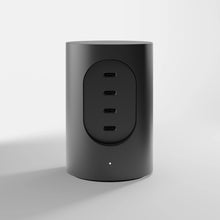
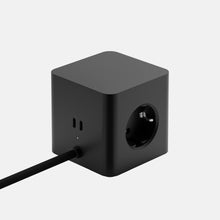
Cylindric UX1 gives up to 100 W from one USB-C port and 165 W across four. Cubical C1 gives up to 65 W from one port. Both use USB Power Delivery 3.1.


Questions
Is 20 W fast charging?
For many phones, yes. Apple lists 20 W or higher for fast charging the iPhone Air and iPhone 17e. Larger phones and laptops take more.
Does fast charging damage the battery?
Not in itself. Heat is what wears a battery, and the device controls how much power it takes.
Why is my phone not fast charging?
One of the three is holding it back. Check that the charger supports USB Power Delivery, that the cable is rated for the watts, and that the phone is not hot.
How do I know if a charger is a fast charger?
Look for USB PD, or PD, on the charger, and for the watts each port gives.
Does the cable affect charging speed?
Yes. Every USB-C cable carries 60 W. Above that, it needs a 5 A cable with an e-marker, up to 100 W.
Is Quick Charge the same as Power Delivery?
No. Quick Charge is Qualcomm's. Power Delivery is the USB standard. Since Quick Charge 4, the two work together.