What is a GaN charger?
A GaN charger uses gallium nitride, not silicon, for the parts that switch the power. Gallium nitride loses less energy as heat and switches faster, so the charger can be smaller for the same watts.

3×a wider band gap than silicon
1990sthe first bright blue LEDs, made from GaN
2014the Nobel Prize in Physics for them
165 WCylindric UX1, a GaN charger
A material, not a standard
Gallium nitride is a compound of gallium and nitrogen. It is a semiconductor, like silicon. It has been in LEDs since the 1990s: the bright blue LED, which won the 2014 Nobel Prize in Physics, is made from it.
Its band gap, the energy it takes to free an electron, is 3.4 eV: about three times that of silicon. It handles higher voltages and temperatures, and its electrons move more freely, so it switches faster.
Why it makes chargers smaller
A charger turns the 230 V from the wall into the 5 to 20 V a device uses. It does so by switching the power on and off very fast and passing it through a small transformer.

GaN loses less energy each time it switches, so less turns into heat. Less heat needs less cooling. Faster switching allows a smaller transformer. Together, the charger shrinks.
GaN and Power Delivery are different things
| GaN | USB Power Delivery | |
|---|---|---|
| What it is | A material inside the charger | An agreement between charger and device |
| What it changes | Size and heat | How much power, at what voltage |
| On the box | GaN | USB PD, or PD |
Speed comes from the watts and from Power Delivery. GaN lets a charger give those watts from a smaller body. More in What is USB-C Power Delivery?


Cylindric UX1: GaN at the desk
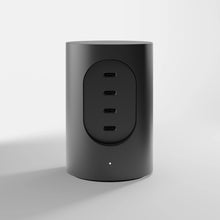
Cylindric UX1 is a GaN charger. 165 W across four USB-C ports, up to 100 W from one, in a cylinder 64.8 mm across and 99.6 mm tall. It uses USB Power Delivery 3.1, and cuts out on over-voltage, over-current, over-temperature and short circuits.

What to look for
- The watts your devices need, and how the ports share them.
- USB Power Delivery on the charger.
- Protection against over-voltage, over-current, heat and short circuits.
- A cable rated for the watts.
The full list is in How to choose a USB-C charger.
Questions
Are GaN chargers safe?
GaN is a material. Safety comes from the design around it: look for over-voltage, over-current, over-temperature and short-circuit protection, and a CE mark.
Is GaN better than silicon?
For chargers, it loses less energy as heat and switches faster, so the charger can be smaller for the same watts.
Do GaN chargers charge faster?
Not by themselves. A 65 W GaN charger and a 65 W silicon charger both give 65 W. Speed depends on the watts, Power Delivery and the cable.
Can I use a GaN charger with an iPhone?
Yes. The iPhone 15 and later fast-charge with a USB-C adapter that supports USB Power Delivery, GaN or not.
Do GaN chargers get warm?
Yes. Every charger turns some power into heat. A GaN charger turns less of it.
What is the difference between GaN and PD?
GaN is what the charger is made with. PD, USB Power Delivery, is how it agrees power with the device. A charger can have both.