What is USB-C Power Delivery?
USB Power Delivery, or USB PD, is how a USB-C charger and a device agree on power. They talk first, settle on a voltage and a current, and only then does the power rise above 5 V. It goes up to 240 W.

5 Vwhere every charge starts
20 Vtop of the standard range, up to 100 W
48 Vtop of the extended range, up to 240 W
2012the first version
A conversation before the power
Plug in a USB-C cable and the charger offers 5 V, nothing more. Then the two ends talk over the cable.

The charger lists what it can supply. The device picks the one it wants. The charger agrees, switches, and says when it is ready.
This is why a laptop charger is safe for a phone. The phone asks for what a phone needs, and gets no more.
The voltages
Power Delivery works in fixed steps. The standard range runs 5, 9, 15 and 20 V, at up to 3 A on any USB-C cable, and up to 5 A at 20 V on a cable built for it. The extended range, added in 2021, adds 28, 36 and 48 V at 5 A.
The extended range is for devices that need more than 100 W.
The versions
- 2012: Revision 1.0, the first version, finalised in July.
- 2014: Revision 2.0, alongside the USB-C connector, with the fixed steps of 5, 9, 15 and 20 V.
- 2015: Revision 3.0. The Programmable Power Supply, PPS, was added to it in 2017.
- 2021: Revision 3.1, in May: the extended range, up to 240 W at 48 V.
- 2023: Revision 3.2, in October: the Adjustable Voltage Supply, AVS, across the standard range.
A newer charger still talks to an older device. The two settle on what both understand.
PPS and AVS: finer steps
Fixed steps suit most devices. Some phones prefer to set the voltage themselves as they charge. PPS lets them ask in steps of 20 mV. Samsung's Super Fast Charging is built on it.
AVS does the same in steps of 100 mV. Apple's newest Pro iPhones reach their top speed on an adapter with AVS and USB Power Delivery 3.2.
The cable has a say
Every USB-C cable carries 3 A: 60 W at 20 V. Above that, the cable needs a small chip, an e-marker, that tells the charger it can carry 5 A. Above 20 V, it needs to be an EPR cable, marked 240 W on both plugs. Without the right cable, the charger stays below it.


USB-C Cord A1 carries 100 W with USB Power Delivery.

Power Delivery on Cords®
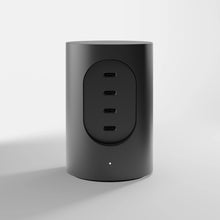
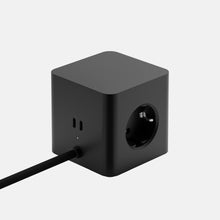
Cylindric UX1 and Cubical C1 use USB Power Delivery 3.1. Both work in the standard range: Cylindric UX1 gives up to 100 W from one port and 165 W across four; Cubical C1 gives up to 65 W.


Questions
Is USB-C the same as USB Power Delivery?
No. USB-C is the connector. Power Delivery is the agreement made over it. Without Power Delivery, USB-C gives up to 15 W. See What is USB-C?
Is USB Power Delivery safe for my phone?
Yes. The phone asks for what it needs, and the charger supplies only that.
What is the difference between PD 3.0 and PD 3.1?
PD 3.1 adds the extended range: 28, 36 and 48 V, up to 240 W. Up to 100 W, they work the same way.
Does the iPhone use USB Power Delivery?
Yes. Apple says the iPhone 15 and later fast-charge with a USB-C adapter that supports USB Power Delivery.
What is an e-marker?
A small chip in a USB-C cable that tells the charger the cable can carry 5 A. Without it, the charger stops at 3 A.
Do I need a special cable for 240 W?
Yes. An EPR cable, rated for 48 V and 5 A, and marked 240 W on both plugs.